Why Does Hypnotherapy Work for Stopping Smoking and Other Habits?
If you’ve ever tried to quit smoking or quit vaping, you’ve probably realized something: it’s not just about the chemical addiction. Something else is happening, under the surface. You can know how much you’re spending on cigarettes or vape pens - hundreds a month, thousands of dollars a year. You can know how it impacts your health. You can know every single reason why you should stop; you can promise your family, swear on your life, even throw away every lighter, cigarette and vape in the house and yet, somehow, you still find yourself lighting up “just one more.”
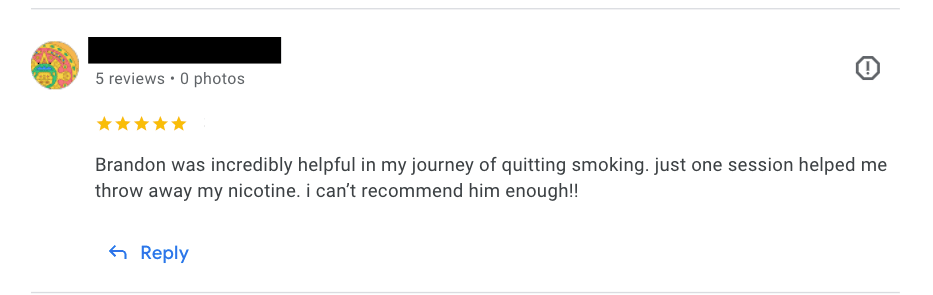
And yet, despite all the struggle people go through… time after time clients will walk out of my office, usually after just one session of hypnotherapy, never to smoke again. I’ve even had clients walk out convinced at a conscious level that they aren’t quite ready to quit… only to discover the change has already happened and cigarettes no longer do anything for them.
That’s because habits don’t live in logic. They live in the subconscious. And that’s exactly where hypnotherapy works its magic.
If you’re thinking about quitting, this blog will help you understand why hypnotherapy is considered the tried and true method by so many who have successfully put nicotine behind them. One session of hypnotherapy may be all that’s between you and a smoke-free life.
Habits Run Deep
So why is it that most people can’t just “turn off” their smoking habit, or other undesired habits? Sure, there’s the chemical addiction that we all know about. But it goes beyond that. For the majority of smokers, smoking isn’t just smoking—it’s an escape, a rebellion, a comfort, or a hundred other things.
Without changing this relationship to smoking, we could be giving up a major part of ourselves when we quit smoking. That’s what makes it hard, and that’s why hypnotherapy works. Hypnotherapy goes to the root, allows you to change that relationship, change the pathways. The chemical addiction still exists, yes, but the chemical addiction is rarely the reason we fail at quitting smoking.

What Actually Happens in Hypnotherapy?
The entertainment industry has had a lot of interesting ideas about hypnosis over the years, almost all of them wildly inaccurate. Because of this a lot of people picture hypnosis as swinging pocket watches and “you are getting sleepy…” But modern hypnotherapy is very different.
In a typical session, you’re guided into a deeply relaxed, focused state. It’s kind of like when you’re daydreaming, or driving a familiar route and suddenly realize you don’t remember the last ten minutes.
You’re not asleep. You’re not unconscious. You’re not under the control of someone else. You’re simply more open and inwardly focused, and deeply relaxed. Many people experience a dreamlike state in which their inner world becomes tangible, feeling transported to another place while still remaining awake and able to respond to prompts.
The normal filters and patterns by which you understand yourself and the world are relaxed in that state, more malleable. It’s almost like putting your brain in editing mode.
Changing Your Perception
We don’t just “experience reality”. If we did, we’d be overwhelmed all day by all the sights, sounds, and sensations, and we’d never be able to get anything done. Instead our conscious mind experiences a version of reality that is shaped by the subconscious, inner processes.
It is your perception of smoking, or your perception of vaping, which keeps you tied to the habit. Have you ever had the experience of “falling out of love?” Someone who you once brought you comfort and joy and feelings of love just… no longer does that. Something changed about the way you perceived them, and once it changed that was it. No going back.
The way we perceive the world can be changed in hypnosis, resulting in a fairly instant switch-flip: you “fall out of love” with smoking. It just doesn’t do anything for you anymore.
The Power of Suggestion (and Why It Works)
If you’ve ever cried during a movie or jumped at a scary scene, you’ve experienced hypnosis in everyday life. You knew it wasn’t real, but your subconscious responded as though it was. The same mechanism that lets you feel suspense in a thriller is what makes hypnotic suggestion so powerful.
During hypnotherapy, the conscious “critical factor” (the part that says, “That won’t work on me”) takes a back seat, allowing new, positive ideas to take root in the subconscious. These ideas might include self-worth, calmness, or a sense of freedom from addiction. Over time, the mind begins to act as if those ideas are true, which, conveniently, makes them become true.
Why Hypnotherapy Works For Smokers
Smoking is one of those habits that’s equal parts physical and psychological. Yes, there’s a chemical component to nicotine addiction, but the bigger challenge is mental.
Smokers don’t light up because their body needs nicotine. They do it because it’s what they do when they’re stressed, bored, socializing, or finishing a meal. It’s tied to emotions, memories, and identity. “I’m a smoker” becomes part of how they think of themselves.
Hypnotherapy targets that identity level. Instead of trying to battle willpower, it gently shifts how you see yourself: not as a smoker who’s trying to quit, but as a non-smoker who simply doesn’t do that anymore. It helps dissolve the old story and install a new one.
And the results can be dramatic. One session is often all it takes for a client to be free from nicotine. Clients are often surprised that the urge has just… gone up in a puff of smoke.
Ready to Quit? Schedule a Free 15-Minute Consultation With Me Now!
“But What If I Can’t Be Hypnotized?”
Many people wonder if they even can be hypnotized. The truth is, everyone who can focus and follow directions can experience hypnosis. You enter mild hypnotic states every day—when you zone out during a movie, scroll through your phone, or get lost in a song. Hypnotherapy just uses that same natural state intentionally.
Some people go deeper, some stay lighter, but depth isn’t everything. Change happens not because you “go under,” but because you’re open and willing to engage your imagination and emotions in a new way.
Finally, it’s important to know that hypnosis is not someone else doing something to you. Hypnosis is a co-creative state, that is, you and your hypnotherapist work together to get you there. Once people understand that this isn’t someone else doing something to them, but them going into a very common altered state, doubts about being hypnotizable usually fade.
The “Aha!” Moment: Belief Meets Biology
Here’s where it gets really interesting: when your subconscious mind accepts a new belief, your body often follows suit.
Say you’ve spent years believing that smoking helps you relax. Under hypnosis, you’re guided to experience genuine relaxation without a cigarette. Your body releases the same calming chemicals like dopamine, serotonin, endorphins, but naturally. After a few repetitions, the brain learns that this new pattern works even better!
You’ve essentially re-wired the association. The same stress triggers that used to make you crave a smoke now remind you to breathe, stretch, or sip water instead. The brain doesn’t care that it’s a new routine, it just follows the reward signal.
That’s why so many people say quitting smoking with hypnosis feels easier than they expected. It’s not a battle of willpower; it’s a change in programming.

Beyond Smoking: The Habit Hypnotherapy Can Help With
Once you understand how this works, it makes sense that hypnotherapy can help with all sorts of habits.
Some common examples:
Nail biting
Overeating
Procrastination
Hair pulling (trichotillomania)
Excessive phone use or social media scrolling
Drinking
Negative self-talk
Quit Vaping
All of these live in the subconscious realm of repetition and reward. Hypnotherapy helps by interrupting that pattern and replacing it with one that aligns with your goals.

The Humor in Habit
If you’ve ever tried to quit something, you know how absurd the human mind can be. One part of you says, “We’re done with this.” Another part says, “Yeah, but what if we just do it one last time… forever?”
That’s why I like to tell clients: don’t take your habits too personally. They’re just outdated coping mechanisms that haven’t realized you’ve evolved. Hypnotherapy is like sitting them down and saying, “Hey buddy, thanks for your service, but we’re moving on.”
It’s surprisingly effective when you approach it with a little lightness and curiosity instead of guilt and shame.
How Many Sessions Does It Take?
That depends on the person and the habit. Truly everyone is different, and you aren’t a failure if it takes more than one session. But yes, for smoking, many people notice a significant shift after just one session. For more complex patterns, like emotional eating or anxiety-based habits, it may take a few more.
Of course, the habit itself doesn’t tell us what’s going on inside. It’s usually just the outer expression of a possible range of inner experiences. That’s why it can be hard to know exactly how many sessions it will take for any specific issue. Until we learn the “why” (or sometimes many whys) we don’t know exactly what we’re working with.
Still, most clients have a big shift within 3 sessions.
Hypnotherapy Isn’t Magic, It’s Just Working With the Right Part of the Mind
To be clear, hypnosis isn’t a miracle cure. You still need willingness and commitment. But when you combine those with subconscious change, it feels less like forcing yourself and more like becoming the kind of person who just doesn’t do that anymore.
That’s what makes hypnotherapy so different from traditional approaches—it doesn’t fight the old habit; it transforms the identity behind it.
You stop trying to “quit smoking” and simply start living as a non-smoker. You stop trying to “resist snacks” and start living as someone who genuinely enjoys feeling healthy and in control.
And when that shift happens, there’s no going back, because the part of you that used to crave the habit simply isn’t there anymore.
Final Thoughts
If you’ve been struggling with smoking or any other stubborn habit, hypnotherapy offers a compassionate, surprisingly practical way out. It helps you access the deeper part of yourself that already knows how to change.
You don’t have to wrestle your subconscious into submission, you just have to speak its language. When you get all your parts on the same page and going the same direction, changing your habits just becomes easy.